

How to Read a CBD Certificate of Analysis (COA) Like a Pro
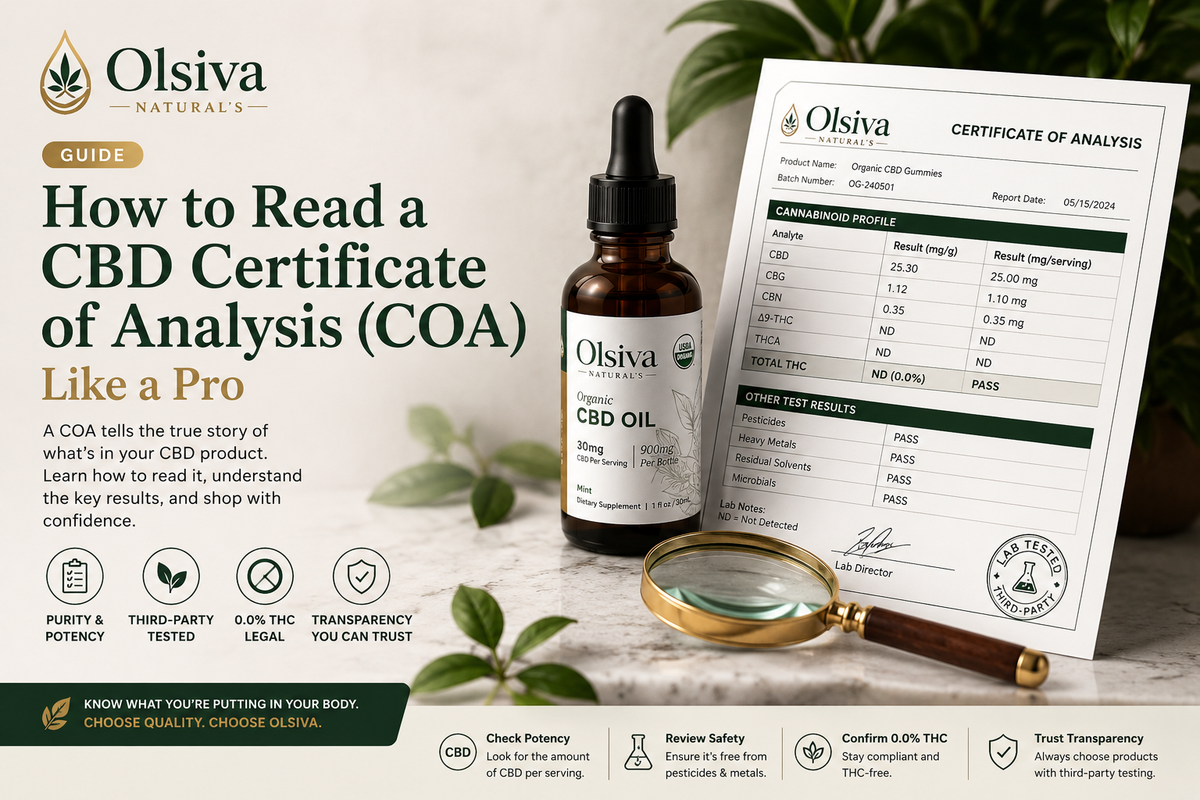
Every CBD brand says "third-party tested." Far fewer make it easy to actually read the document that backs that claim up. A Certificate of Analysis (COA) looks like a wall of chemistry at first glance, but you only need to know where to look. Here's how to read one in about two minutes, and what should make you close the tab and buy elsewhere.
What a COA actually is
A COA is a report from an independent lab — not the brand itself — that tested a specific batch of product and recorded what's actually in it. The word to focus on is independent: a legitimate COA carries the testing lab's name, accreditation, and a report date, because the whole point is that it wasn't written by the company selling you the bottle. If the only potency or purity claim you can find is on the brand's own label copy, that's not a COA — that's marketing.
The four things worth checking first
- Cannabinoid panel. This confirms the CBD content actually matches what's on the label. A gummy claiming 25mg should show something close to 25mg on the panel, not 12mg or 40mg.
- The THC line specifically. Look for "ND" (non-detect) if the product is sold as THC-free, or a specific sub-0.3% number if it's full- or broad-spectrum. This single line is the difference between a product that won't show up on a drug screen and one that, cumulatively, might.
- Contaminant screening. A thorough COA also tests for pesticides, heavy metals, residual solvents, and microbials — not just cannabinoids. Hemp is a bioaccumulator, meaning it pulls contaminants from the soil it's grown in, so this panel matters as much as the potency numbers.
- Batch number match. The COA should reference a batch or lot number, and that number should match what's printed on your actual bottle. A COA with no batch number, or one that doesn't correspond to anything on your product, isn't verifying what you're holding.
Red flags that mean the COA isn't doing its job
Watch for a report with no date, a report that's more than a year or two old relative to when you bought the product, a testing lab you can't find any information about, or numbers that don't reasonably line up with the label claim. Any one of these means the "third-party tested" label is doing more marketing than the actual document is doing verification.
Where to find Olsiva's COAs
Every Olsiva batch is tested by an independent lab, and results are published — searchable by the batch number printed on your product — on our Lab Results page. If you can't find your batch listed, or a number doesn't match, reach out and we'll get it sorted.
A COA is the one piece of paperwork that tells you what's actually in the bottle, independent of anything the label says. It's worth the two minutes it takes to check.
These statements have not been evaluated by the Food and Drug Administration. This product is not intended to diagnose, treat, cure, or prevent any disease.