

Hemp vs. Marijuana: The Legal Line Explained in Plain English
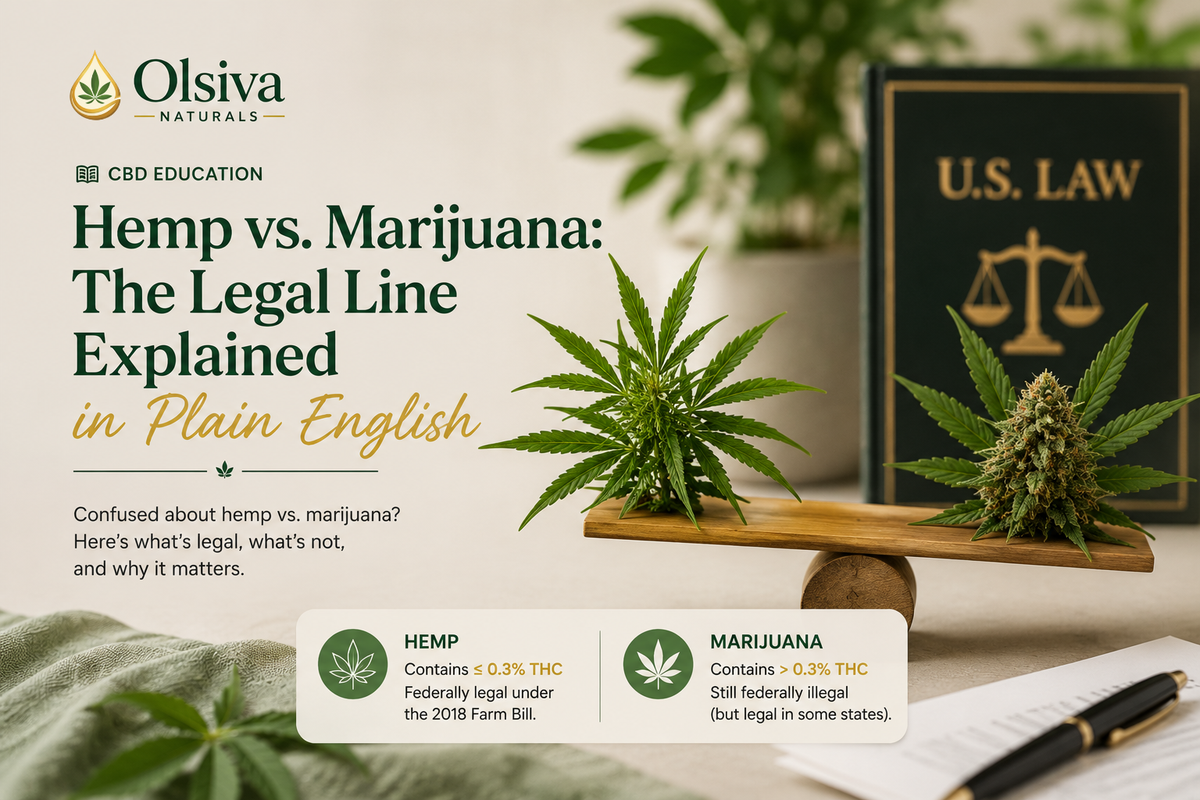
Hemp and marijuana are the same plant species. The entire legal distinction between them — legal nationwide vs. federally restricted — comes down to one number. Here's what that number is and why it matters for anything you buy.
Same species, one dividing line
Both hemp and marijuana are Cannabis sativa. What separates them legally isn't genetics or appearance — it's THC content. Under the 2018 Farm Bill, hemp is federally defined as cannabis containing no more than 0.3% delta-9 THC by dry weight. Cross that threshold, and the same plant is legally classified as marijuana, regardless of what it looks like or where it was grown.
What the 2018 Farm Bill actually changed
Before 2018, all cannabis — hemp included — was federally classified as a controlled substance. The 2018 Farm Bill carved hemp out of that classification specifically, legalizing its cultivation and the sale of hemp-derived products nationwide, provided they stay under the 0.3% THC threshold. That single bill is the legal foundation for the entire hemp-derived CBD industry, including every product Olsiva sells.
Why 0.3% specifically
The number itself isn't about safety or effect — at that level, THC isn't intoxicating in any meaningful sense. It's a regulatory line that Congress adopted from earlier agricultural research into industrial hemp, and it's stayed the legal threshold ever since, even as the market around it has grown into gummies, tinctures, and topicals nobody was thinking about when the number was first proposed.
Where CBD fits into this
Because hemp and CBD aren't the same thing, it's worth being precise here too. CBD is one of dozens of compounds found in the cannabis plant — hemp or marijuana. Hemp-derived CBD products are legal at the federal level because they come from hemp, not because CBD itself was specifically legalized as a compound. That's also why the THC content of a specific hemp product still matters even though CBD is the main active ingredient: a full-spectrum product can be entirely legal hemp and still carry trace, federally compliant THC, while a THC-free product removes it down to non-detect.
What this means day to day
For anyone buying hemp-derived CBD, the practical upshot is this: a legitimate product should be traceable back to hemp, not marijuana, and its Certificate of Analysis should confirm THC at or under the 0.3% federal threshold. That's the line that determines whether what you're holding is a federally legal hemp product or something else entirely — and it's worth checking, not assuming.
For a deeper look at how this plays out across full-spectrum, broad-spectrum, and THC-free formulations, see our CBD Education Guide.
These statements have not been evaluated by the Food and Drug Administration. This product is not intended to diagnose, treat, cure, or prevent any disease. This article is for general information only and is not legal advice; cannabis and hemp law varies by state and is subject to change.