

Perimenopause, Unfiltered: What CBD Actually Does for Hot Flashes, Sleep, and Mood
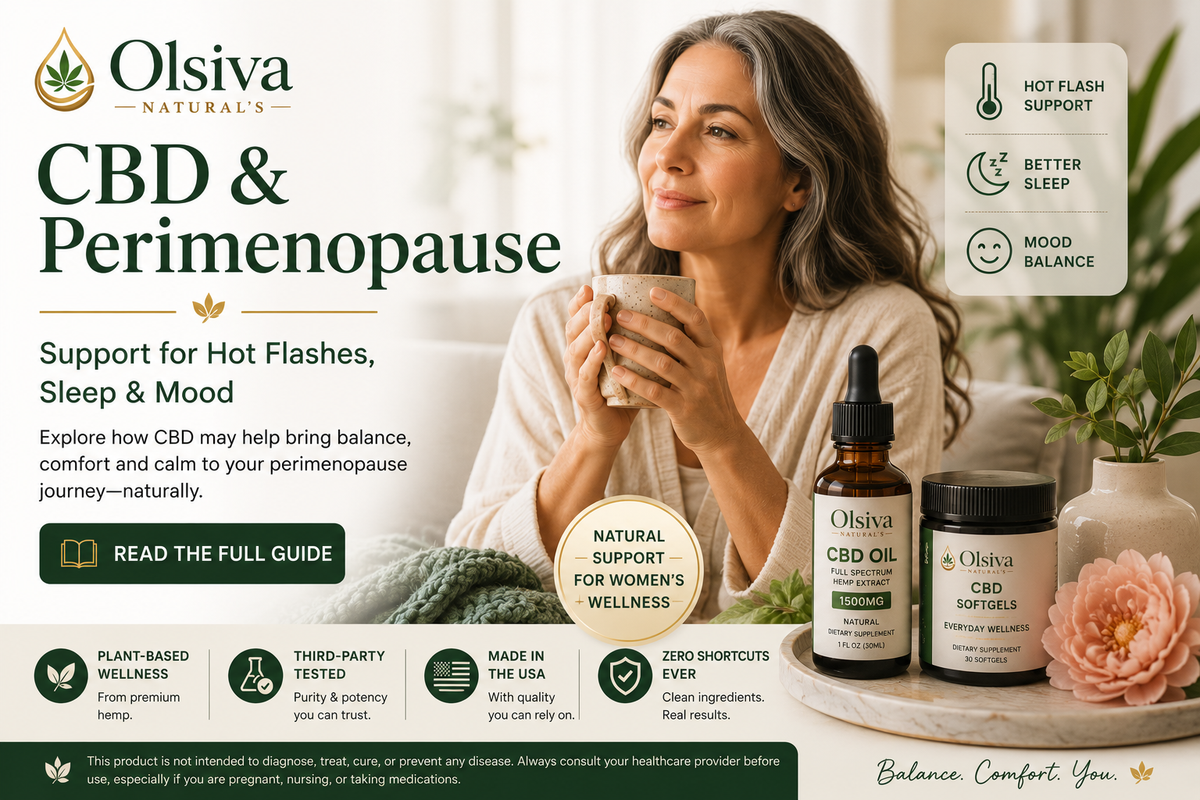
Search "CBD for menopause" and you'll find dozens of pages promising it fixes hot flashes, sleep, and mood in one dropper. We're not going to do that here. Perimenopause is getting more research attention than it has in decades, and the honest answer about where CBD fits is more interesting — and more useful — than the marketing version.
What's actually happening during perimenopause
Perimenopause, the transition years before menopause, is driven by fluctuating — not just declining — estrogen and progesterone. That fluctuation is what produces the signature trio: hot flashes and night sweats (vasomotor symptoms), disrupted sleep, and mood swings or anxiety that can feel disproportionate to whatever triggered them. Because these three symptoms compound each other — poor sleep worsens mood, hot flashes wreck sleep, anxiety makes hot flashes feel worse — women in this stage are increasingly looking outside standard HRT for something to take the edge off, and cannabinoids have become one of the most searched options.
What the research actually shows — symptom by symptom
Sleep. This is the area where the evidence is most humbling. A 2025 systematic review covering more than 1,000 participants found that CBD taken alone showed no statistically significant effect on sleep quality. The sleep benefit that shows up in cannabis research is driven more by CBN and THC than by CBD in isolation. That said, real-world surveys tell a different story: women in perimenopause who use cannabis products consistently name sleep improvement as their primary reason for using it and the symptom they find most reliably helped. The likely explanation is that full-spectrum products — which include trace amounts of CBN, THC, and other minor cannabinoids alongside CBD — are doing work that a CBD-isolate product isn't built to do.
Hot flashes. The evidence here is genuinely mixed. Some women report a meaningful drop in frequency and severity of hot flashes; others notice nothing. There's a plausible mechanism — CBD interacts with serotonin receptors that also play a role in the body's temperature regulation — but "plausible mechanism" is not the same as "proven effect," and no large controlled trial has confirmed it yet.
Mood and anxiety. This is where the anecdotal reporting is strongest and most consistent, though it still lacks the large randomized trials that exist for CBD's better-studied uses. In one survey, 74% of women using cannabis products for menopause-related symptoms reported relief across hot flashes, sleep, and mood combined.
What's coming
The research gap hasn't gone unnoticed. A Phase 2 clinical trial is currently underway specifically evaluating hemp-derived cannabinoids for menopausal symptoms, and a separate 2026 double-blind, placebo-controlled trial out of Macquarie University and the University of Sydney found CBN — not CBD — improved several measures of sleep quality. Over the next few years, expect the conversation to shift from "does CBD help menopause" to "which cannabinoid, at what ratio, helps which symptom" — a much more useful question than the one most marketing currently answers.
What this means if you're deciding whether to try it
- If sleep is your primary target, a full-spectrum product (which includes trace THC and minor cannabinoids like CBN, not a CBD-isolate) has more evidence behind it than a THC-free product, based on current research.
- If mood and daytime anxiety are the bigger issue, a THC-free tincture or softgel you can take consistently through the day is a reasonable starting point, and won't affect your ability to drive or work the way a full-spectrum evening product might.
- Talk to your doctor first, especially if you're on hormone replacement therapy or any prescription medication — cannabinoids are metabolized by the same liver enzyme pathway as many common drugs, and that interaction is worth a real conversation, not a guess.
- Give it real time before judging it. Most of the survey data behind these reported benefits comes from consistent, longer-term use, not a single dose.
Perimenopause doesn't have a single fix, and neither does any one cannabinoid. But if you're going to try CBD as part of managing it, going in with an accurate picture of what's actually been studied — and what hasn't — is a better starting point than a headline that promises more than the research does.
Olsiva offers both full-spectrum tinctures (with trace, federally compliant THC and minor cannabinoids) and THC-free options, each independently lab-tested, so you can choose the formulation that matches what you're actually trying to address.
These statements have not been evaluated by the Food and Drug Administration. This product is not intended to diagnose, treat, cure, or prevent any disease. Consult your physician before starting any new supplement, particularly if you are taking hormone replacement therapy or other prescription medication.